The Defender's Advantage Is Bigger Than the AI Threat
Security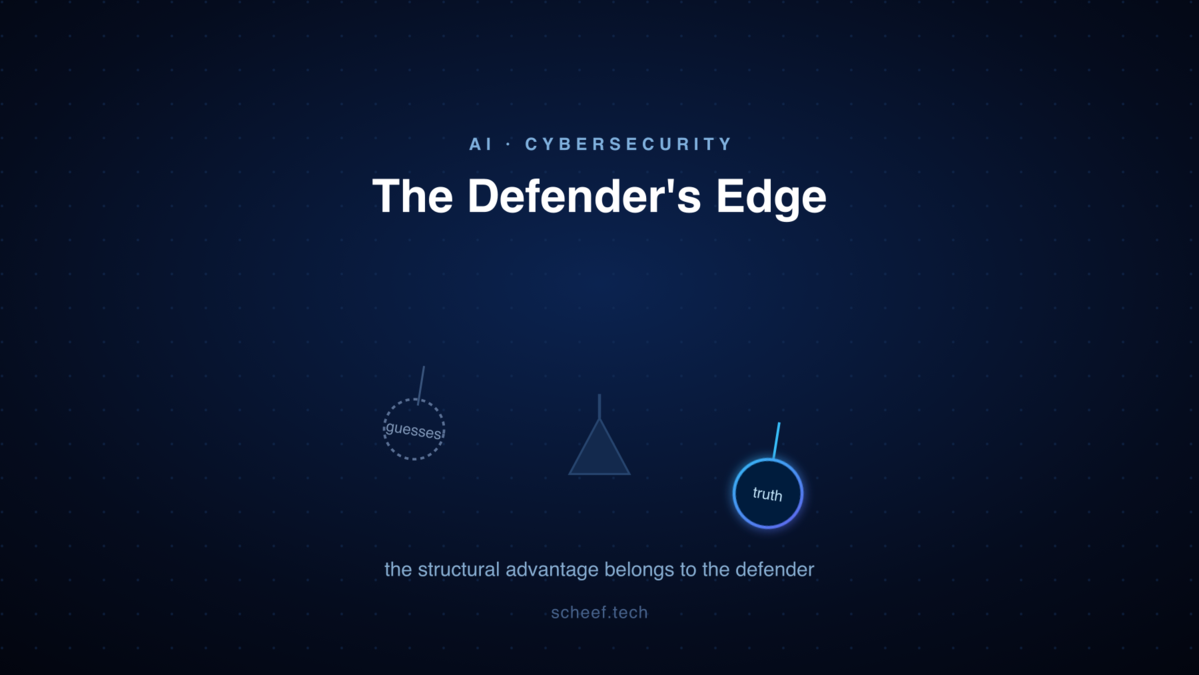
An attacker probing your network begins with incomplete information — stolen credentials, public data, educated guesses about what might be running and why. You, the defender, can work from the source of truth, if you have invested in seeing your own environment clearly. That gap, more than any model release, decides who comes out ahead in the AI era.
The Fear Is Real, But It's Narrow
AI does make some attacker activity easier, and pretending otherwise helps no one. The honest threat has two shapes. At the perimeter, AI lowers the skill floor for commodity tactics and raises the volume of low-effort attempts: phishing reads more fluently, voice and video can be convincingly faked, and a novice can produce something that looks competent. After a compromise, AI can also accelerate parts of an intruder's work, helping them make sense of what they find faster.
That is a meaningful shift in scale and tempo, but not, on its own, a smarter adversary who understands your business. The genuinely hard parts of an intrusion remain less tractable for a machine working from the outside: understanding an unfamiliar environment and inferring the logic of systems it cannot read are still slow and error-prone. A model that drafts a convincing email does not, by itself, hand anyone a map of your network. Once a foothold exists, though, AI can help an attacker turn harvested configuration and telemetry into a usable picture, which is one more reason to limit standing privileges and watch for unusual outbound traffic.
So the threat is best understood as more noise at the perimeter plus faster movement once inside, not an omniscient opponent who arrives already knowing your systems. Treating it as the latter funds the wrong investments and breeds a defeatism that assumes the defender is outmatched. The published evidence supports the narrower reading: year after year, the Verizon Data Breach Investigations Report traces most incidents back to stolen credentials, phishing, and unpatched exposure — the same fundamentals AI makes louder, not categorically new attacks that read your business logic.
What Defenders Have That Attackers Don't
The structural asymmetry runs in the defender's favor, and AI widens it before a compromise rather than closing it. None of these advantages is automatic, though; each is something you can and should hold, if you invest accordingly.
The table below makes the contrast concrete: the defender starts from facts, the attacker from inference.
| Dimension | What the defender holds | What the attacker must infer |
|---|---|---|
| Ground truth | An authoritative inventory of accounts, assets, and owners | A guessed map assembled from stolen fragments and public data |
| Business context | What normal traffic looks like at 3 a.m. on a Sunday; which service account is dormant by design | No idea what is routine, so every move risks tripping a signal |
| Legitimate access | Every log, every endpoint instrumented from the inside | A fight for each foothold, working blind around what they cannot read |
| Ability to act | Rotate a credential, isolate a segment, revoke a token, push a rule | Routine for the owner, high-risk and noisy for the intruder |
Ground truth and business context
A defender can hold ground truth and business context: which accounts are legitimate, what normal traffic looks like at 3 a.m. on a Sunday, that one service account is dormant by design. A defender can also hold legitimate access, reading every log and instrumenting every endpoint where an attacker fights for each foothold. But both edges are only as good as your coverage. Most organizations have real blind spots in SaaS, third-party integrations, and mobile and operational technology, where telemetry is thin and privacy constraints apply, so the work is logging that reaches identity, SaaS, and API activity, not just the network edge.
The ability to act — and where it gets fragile
A defender can also act decisively inside their own environment: rotate a credential, isolate a segment, revoke a token, push a rule. Routine for the owner, high-risk for the intruder. This is where the asymmetry is most fragile, though: after initial access, the gap narrows as an attacker harvests the same telemetry you rely on, which is why rapid containment, least privilege, segmentation, and credential rotation matter most for denying AI-accelerated lateral movement. Mapping your detections against a shared framework like MITRE ATT&CK turns that abstract "post-compromise movement" into specific, testable behaviors you can hunt for.
Now layer AI onto each of these. The attacker's AI still works from the outside, on guesses and stolen fragments; the defender's works on top of a complete, labeled, authoritative picture, where one is maintained. The same technology amplifies a stronger position on one side and a weaker one on the other.
Where AI Actually Compounds the Defender's Edge
The practical wins are not exotic. They come from applying AI to work defenders already do but cannot do at scale.
- Scaling analyst judgment. The bottleneck in most security operations is attention, not data. AI can triage routine alerts, summarize incidents in plain language, draft a first investigation timeline, and surface the events that warrant a person, so judgment is spent on decisions, not copy-pasting between consoles.
- Continuous monitoring against a known-good baseline. Because the defender can hold ground truth, deviation becomes a meaningful signal, and AI is well suited to flagging what does not fit in a large, noisy stream. To keep that useful, refresh the baseline continuously and tie it to change management, so seasonal spikes and planned change windows do not drown analysts in false positives.
- Faster detection and response. Time-to-detect and time-to-contain decide how bad an incident gets, and industry reporting — including IBM's annual Cost of a Data Breach research — consistently links shorter breach lifecycles to lower cost while pointing to automation as a factor in containing incidents sooner. Compressing the path from signal to action is where AI helps, and acting inside your own systems turns a faster decision into a faster outcome.
- Closing the knowledge gap. Not every organization has a senior incident responder on call. AI lowers the skill floor for defenders too, letting a smaller team reason about an alert or draft a response plan with more competence than headcount allows.
A Checklist for Decision-Makers
The advantage rewards the side that operationalizes it. To press the defender's edge, this is the order of work that pays off.
- Unify asset inventory and owner mapping. Know what you have and who is accountable for each system, including SaaS and third parties.
- Centralize and normalize logs. Pull network, endpoint, identity, SaaS, and API activity into one place in a consistent shape, so signals across domains can be correlated.
- Define response authority and playbooks. Decide in advance who may isolate a host, revoke a token, or rotate a credential, and write the steps down before you need them.
- Integrate AI into triage and summarization with a human in the loop. Let it draft and prioritize; keep a person on every consequential decision.
- Measure time-to-detect and time-to-contain. Tracked over time, these tell you whether what you bought moved the needle.
- Harden against post-compromise movement. Enforce least privilege and segmentation, and make credential rotation routine, not reactive.
- Run periodic defensive purple-team drills. Exercise detection and response against realistic scenarios so playbooks, telemetry, and people are tested before an incident tests them.
Govern the AI You Adopt
AI tooling introduces new surface area, so govern a security assistant like any privileged system: scope its access with role-based controls and minimize the data it can reach, test it for prompt injection and data-exfiltration paths before trusting it, log its inputs and outputs for audit, and keep a clear way to turn it off without losing your ability to respond. In practice, that scoping should be explicit and reviewable rather than assumed — closer to a least-privilege policy than a blanket grant:
assistant:
  role: soc-triage
  permissions:
    - read:alerts
    - read:logs
    - draft:incident-summary
  denied:
    - write:firewall-rules   # humans only
    - read:hr-records        # out of scope
  audit: all-inputs-and-outputs
  kill_switch: enabled
Used as an assistant to skilled people, the upside is large; used as an unsupervised oracle, it manufactures new risk. The difference is design, not the technology.
The Real Risk Is Under-Adoption
An organization that could hold ground truth but never instruments it, or could act decisively but cannot decide who has the authority, has surrendered the advantage without an attacker doing anything clever. The failure mode worth worrying about is a defender who reads the headlines, concludes the situation is hopeless, and pours budget into the scariest threat rather than the most probable one, delaying the unglamorous work the AI tooling depends on to be useful.
Among the most costly strategic mistakes we see right now is not buying the wrong AI tool. It is assuming you are on the losing side and acting accordingly.
Playing the Stronger Hand
The defender can start the game knowing the board. AI does not change who holds that knowledge; it changes how much can be done with it. The organizations that come out ahead will not be the ones with the most alarming threat slides, but the ones that did the ordinary work of knowing their own systems, then used AI to act on it at a speed an adversary working from incomplete information cannot match. The advantage is within reach; the open question is whether you build it and use it. A security partner worth having helps you press that edge rather than sell you the fear.
Other Posts
 Security
The Human Gate: Where AI Belongs in Security Work, and Where It Must Be Stopped
Yannic Scheef 04 Jun 2026 Security
SOC-Grade Security Without a SOC: What AI Actually Closes
Yannic Scheef 02 Jun 2026 Security
Adopting AI in Your Security Practice Without Inheriting New Risk
Yannic Scheef 01 Jun 2026 Design
Designing for Scalability
Yannic Scheef 02 Aug 2025 Product
From MVP to Market-Ready
Yannic Scheef 02 Aug 2025 Software Engineering
Resilience Is Triage, Not a Checklist
Yannic Scheef 25 Jul 2025 AI & Automation
Practical AI for Small Businesses
Yannic Scheef 20 Jul 2025 E-Commerce
Optimizing Your Shopify Store
Yannic Scheef 18 Jul 2025 Digital Strategy
Future-Proofing Your Web Presence
Yannic Scheef 15 Jul 2025