From MVP to Market-Ready
Product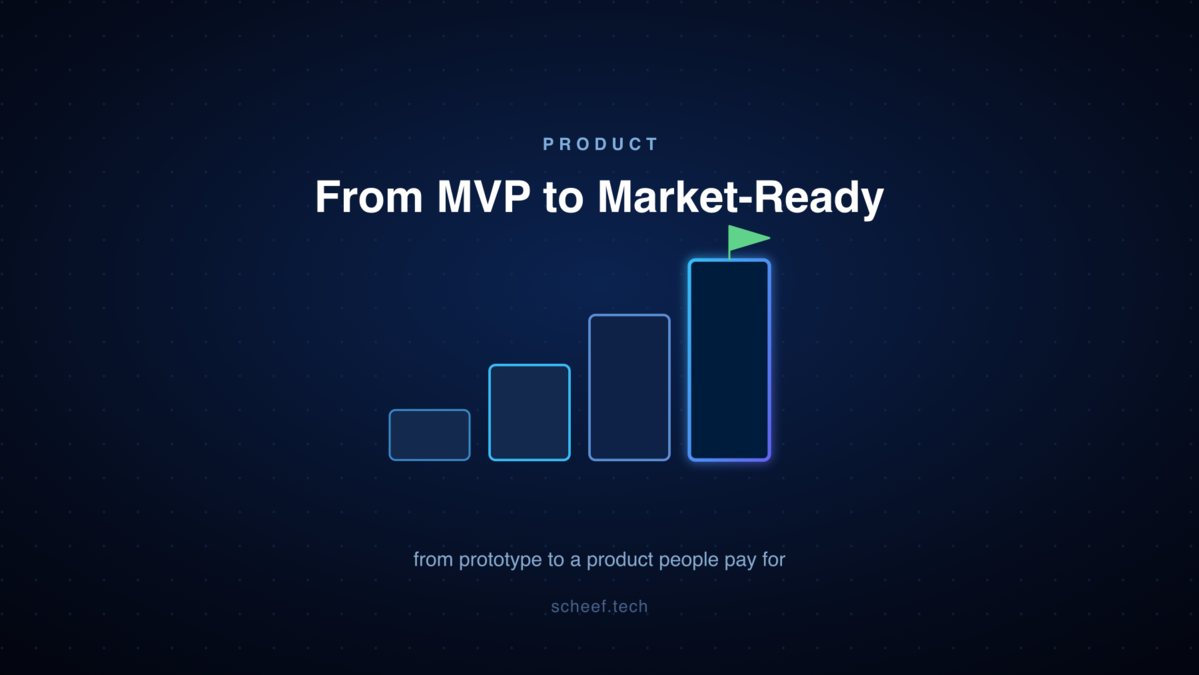
An MVP exists to answer one question: will anyone use this? Once the answer is yes, the job changes completely. The prototype that proved demand is rarely the product that can survive a paying customer base, and the transition between the two is where a lot of promising companies quietly stall.
Market-ready does not mean feature-complete. It means a product that a stranger can adopt, rely on, and pay for without a founder hovering nearby to patch the cracks. Getting there is a sequence of deliberate decisions, not a single rewrite.
It helps to see the two states side by side. The same dimensions exist in both — what changes is who carries the load when one of them fails.
| Dimension | MVP | Market-ready |
|---|---|---|
| Reliability | Breakage discovered when a user complains | Alerting on critical paths; you know first, fix before most notice |
| Onboarding | Founder walks each user through it personally | A stranger reaches first value unaided in the opening session |
| Support | Ad-hoc DMs, promises made on the fly | One monitored channel, fast honest answers, only deliverable remedies |
| Observability | Print statements and guesswork | Searchable logs, error tracking, uptime monitoring |
| Security | Trust the happy path; auth is "good enough" | Authorization enforced per request; billing state and access stay in sync |
Harden what touches money and trust first
When you sharpen a rough product, the temptation is to start with whatever annoys you most. Resist that. The order that matters is determined by blast radius: fix the things that, when they break, cost a customer money, data, or confidence.
In practice, that usually means three areas before anything else:
- Authentication and authorization. Can a user see another user's data? Can a canceled account still act? These are not edge cases at scale — they are incidents waiting for a date.
- Payments and billing state. A prototype often fakes or hand-holds this. A market-ready product handles failed charges, refunds, proration, and the gap between "they paid" and "they have access" without a human in the loop.
- Data integrity. Backups that are actually tested by restoring them, migrations that cannot silently lose rows, and a clear record of who changed what.
If you want a concrete order of operations, harden in this sequence — each step assumes the one before it is done:
- Authorization on every request. Confirm the logged-in user is allowed to touch the specific record they asked for, not just that they are logged in.
- Billing-to-access sync. A payment event must reliably grant or revoke access without manual reconciliation.
- Tested restores. Run an actual restore from backup. An untested backup is a hope, not a safeguard.
- Safe migrations. No schema change that can drop rows without a loud, blocking failure.
- Audit trail. A durable record of who changed what, so an incident can be reconstructed.
Everything else — the slow page, the awkward form, the missing dark mode — can wait behind these. A clumsy interface loses you a sale. A billing bug or a data leak loses you a reputation, and those do not come back at the same price.
Technical debt is a loan, so know the interest rate
Speed early on is correct. The shortcuts that got you to product-market fit were good decisions, made with limited information, under time pressure. The mistake is treating all of that debt as equally urgent to repay once you have momentum.
Debt comes in two kinds. The first is contained: an ugly function, a hardcoded value, a screen built in a hurry. It is local, and you pay for it only when you touch that spot again. The second is structural: a data model that cannot represent a second customer type, an architecture where every new feature requires touching ten files, a deployment process only one person understands. This kind compounds. Every week you build on top of it, the cost of fixing it rises.
Pay down structural debt before it sets, and let contained debt sit until it actually gets in your way.
A useful test makes the call concrete. If a piece of debt slows down every future change, schedule it now. If it slows down only the next change to one feature, fix it when that feature comes up again. This keeps you fast where speed is harmless and disciplined where it isn't. Refactoring everything because it offends your sense of craft is its own form of waste.
One common structural fix is pulling environment-specific values out of the codebase and into configuration, so a second deploy target stops requiring a code change. The twelve-factor app framing captures the principle well — strict separation of config from code:
# Before: hardcoded, only one customer can exist
DB_URL = "postgres://prod-db.internal/acme"

# After: read from environment, any tenant can deploy
DB_URL = os.environ["DATABASE_URL"]
if not DB_URL:
    raise RuntimeError("DATABASE_URL is required")
Reliability, onboarding, and support are product features
Past the prototype, three things determine whether a customer stays, and none of them appear on a typical feature roadmap.
Reliability
Uptime is the floor, not the goal. You need to know when something breaks before your customers tell you. That means error tracking, basic uptime monitoring, and logs you can actually search. The investment is small and the payoff is large: the difference between "a customer emailed us angry about a bug we didn't know existed" and "we fixed it before most people noticed" is a few hours of setup. Add alerting on the paths that matter — login, checkout, the core action your product exists to perform — and you've covered most of what actually goes wrong. The path each request takes through those layers is also where you place your guardrails:
Onboarding
Your earliest users forgave a confusing first ten minutes because they were invested or because you walked them through it personally. Strangers will not. In practice, the users who reach their first real result in the opening session are the ones who are still around a month later, and the ones who stall in that session rarely come back to try again. Watch real new users move through your product without coaching them — structured usability observation, the kind decades of usability research keeps confirming, tells you more than any analytics dashboard. The places they hesitate are your backlog, ranked.
Support
You do not need a help desk on day one. You need one channel a customer can actually reach — a monitored support inbox or an in-app message widget is plenty — plus fast honest answers and, this matters, the discipline to only promise remedies your system can actually deliver. A support reply that offers a fix you cannot execute is worse than saying nothing. Treat recurring questions as bugs in the product, not in the customer.
The signals that say you're ready to scale
Scaling before you're ready multiplies your problems instead of your revenue. A few honest indicators tell you the foundation will hold:
- Growth happens without you in the room. Users sign up, activate, and pay without a founder demo or a manual nudge. The funnel runs on its own.
- Your support volume falls per customer, not just in total. If each new cohort generates fewer tickets than the last, your product is teaching itself. If tickets scale linearly with users, scaling just buys you a bigger fire.
- Incidents are rare, scoped, and understood. When something breaks, you know within minutes and the cause is one system, not a mystery spanning the whole stack.
- Adding a customer costs you almost nothing. No manual provisioning, no per-account spreadsheet, no founder intervention. The marginal customer is cheap.
If you want a faster gut check, watch for these green lights — when several hold at once, the foundation is usually load-bearing:
- A new customer can go from signup to first value with zero messages to you.
- Your performance metrics stay flat as traffic climbs — solid core web vitals under real load, not just on your laptop.
- You can deploy on a Friday afternoon without dread.
- Onboarding a teammate to on-call takes a document, not a person.
When these hold together, more demand makes you stronger. When they don't, more demand exposes every shortcut at once, usually at the worst possible moment.
The takeaway
The path from MVP to market-ready is mostly about sequence and judgment, not raw effort. Harden what protects money and trust first. Treat technical debt as a loan and pay down only the debt that compounds. Invest in reliability, onboarding, and support before you think you need to, because by the time you obviously need them, you've already lost the customers who hit the gaps. Then let the real signals — self-serve growth, falling per-customer support, scoped incidents, near-zero cost per new customer — tell you when to push.
The questions worth asking are not "what can we build next," but "what will break first, what will it cost, and what should we make boring before we make it bigger." A product becomes market-ready the moment it stops depending on the people who made it.
Other Posts
 Security
The Human Gate: Where AI Belongs in Security Work, and Where It Must Be Stopped
Yannic Scheef 04 Jun 2026 Security
The Defender's Advantage Is Bigger Than the AI Threat
Yannic Scheef 03 Jun 2026 Security
SOC-Grade Security Without a SOC: What AI Actually Closes
Yannic Scheef 02 Jun 2026 Security
Adopting AI in Your Security Practice Without Inheriting New Risk
Yannic Scheef 01 Jun 2026 Design
Designing for Scalability
Yannic Scheef 02 Aug 2025 Software Engineering
Resilience Is Triage, Not a Checklist
Yannic Scheef 25 Jul 2025 AI & Automation
Practical AI for Small Businesses
Yannic Scheef 20 Jul 2025 E-Commerce
Optimizing Your Shopify Store
Yannic Scheef 18 Jul 2025 Digital Strategy
Future-Proofing Your Web Presence
Yannic Scheef 15 Jul 2025